April 1st Calendar 2026: Weekday, Dates and Key Facts
Use this April 1st calendar to check the weekday for April 1 in any year, with nearby dates, ISO formats and printing tips for 2026 and 2027.
April 1, 2026 falls on a Wednesday and is the 91st day of the year. In 2027 the same date lands on a Thursday, and by 2028 it has jumped to a Saturday.
So why do so many printed calendars still treat April 1 as a fixed point? Many people answer the weekday question by glancing at last year's page and adding one, which works until a leap day intervenes. The bigger gap sits elsewhere: a calendar that labels April Fools' Day tells you nothing about whether your district is on spring break, whether a filing deadline is bearing down, or whether the date you typed into a spreadsheet will survive export. April 1 needs to be calculated, not remembered, and its neighbours need to be sorted by what they require of you.
April 1 Weekday and Day Number by Year
The reference point is unambiguous. April 1, 2026 falls on a Wednesday and is the 91st day of the year, as published on the April 1 date reference. Every other row in the table below follows from that anchor plus one arithmetic rule.
| Year | Weekday of April 1 | Day of the year | Leap year |
|---|---|---|---|
| 2025 | Tuesday | 91 | No |
| 2026 | Wednesday | 91 | No |
| 2027 | Thursday | 91 | No |
| 2028 | Saturday | 92 | Yes |
| 2029 | Sunday | 91 | No |
| 2030 | Monday | 91 | No |
Two details carry the whole system. The day number holds at 91 in a common year because January, February and March add up to 90 days, putting April 1 one day past that total. In 2028 it becomes 92, since February 29 falls before April 1 and pushes everything back by a day.
Why the Weekday Advances by One or Two
A common year runs 365 days, which is 52 full weeks plus one extra day. That leftover day shifts every date in the following year forward by a single weekday. A leap year inserts February 29 ahead of April, so the shift doubles to two weekdays.
Quick check: if April 1 was a Wednesday this year, it's a Thursday next year, unless a February 29 sits between the two.
Recalculate April 1 for Any Year
- Find the weekday of January 1 for the target year on any year-at-a-glance page.
- Add 90 days for a common year, or 91 days if the year is a leap year.
- Take the total modulo 7 and step that many weekdays forward from January 1, wrapping from Saturday back to Sunday.
Run it on 2026. January 1 is a Thursday, and 90 modulo 7 is 6, so you step six weekdays forward: Friday, Saturday, Sunday, Monday, Tuesday, Wednesday. The result matches the published Wednesday. Try 2028 and the picture changes: January 1 is a Saturday, 91 modulo 7 is 0, and April 1 stays on Saturday with day number 92.
Dates Around April 1 in 2026 and 2027
The window that matters for planning is the three days on either side of the date. Because April 1 moves, the whole window shifts with it.
| Date | 2026 weekday | 2027 weekday |
|---|---|---|
| March 30 | Monday | Tuesday |
| March 31 | Tuesday | Wednesday |
| April 1 | Wednesday | Thursday |
| April 2 | Thursday | Friday |
| April 3 | Friday | Saturday |
| April 4 | Saturday | Sunday |
The visible difference is where the weekend lands. In 2026 the window opens on a Monday and closes with a single Saturday, so five of its six days are workdays. In 2027 the window opens on a Tuesday and ends on a Sunday, leaving four workdays and a weekend tucked inside the tail.
Counting Workdays in a Review Period
Take a common task: a two-week processing, review or delivery window running from April 1 through April 15 inclusive. Count it out and you get 11 weekdays in 2026 and 11 weekdays in 2027, even though the two windows start on different days. That symmetry is a coincidence of where the weekends fall, not a rule.
The reliable method is to strip out full weeks first. April 1 to April 15 is 15 calendar days, which is two full weeks plus one day. Two weeks give you ten weekdays, and the single leftover day adds one more if it isn't a weekend. Then walk the partial week day by day to confirm the total.
Do that count only after the schedule is confirmed, because it subtracts nothing for closures. A district spring break or a company shutdown removes days that the arithmetic happily counts as available. For a month-level view that shows those surrounding weeks in full, the April 2027 calendar lays out the whole month with the weekday columns aligned.
For any year outside this pair, start with the method from the section above, then build the window backwards and forwards from that weekday. April 1 sets the anchor, and the six rows follow in order.
Holidays, Deadlines and Observances Near April 1
April Fools' Day falls on Thursday, April 1, 2027, and it is not a federal holiday. The 2027 April date listing puts three very different entries in the same month: the US federal income-tax filing deadline on Thursday, April 15, and Passover from sundown on April 21 through April 29. Printing them as equal holidays is where calendars go wrong.
| Date (2027) | Observance or deadline | Type | Action required |
|---|---|---|---|
| April 1 (Thursday) | April Fools' Day | Cultural observance | None; not a US federal holiday |
| April 1 to 2 | Spring break in some districts | School schedule | Check the local school calendar |
| April 15 (Thursday) | US federal income-tax filing deadline | Statutory deadline | File or request an extension |
| April 21 to 29 | Passover (begins at sundown April 21) | Religious observance | Plan around evening start and daily observance |
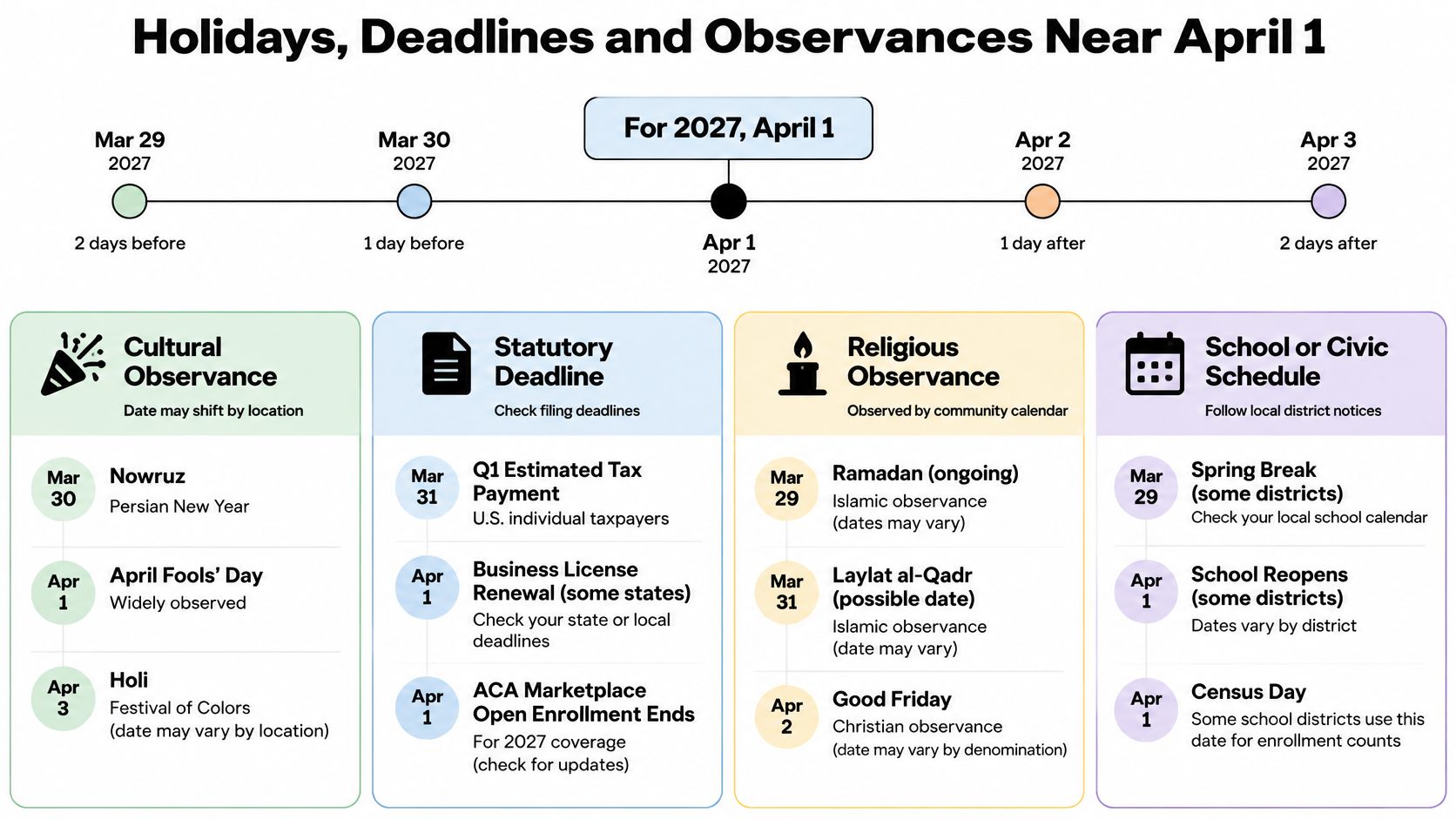
Sorting Dates by Consequence
Cultural observance changes tone, not obligations. A prank in a staff chat or a classroom activity is the extent of it, and April 1 carries no legal weight.
Statutory deadline carries a clock. The federal filing date is the one entry in this window that can trigger a penalty if it slips, and state filing dates can differ from the federal one, so the federal date is a starting point rather than a complete answer.
Religious observance carries a timing rule. Passover begins at sundown, not at midnight, which means the evening of April 21 matters as much as the daylight hours of April 22. Calendars that print only a date and no start time mislead anyone arranging travel, work shifts or a shared meal.
School and civic schedules carry local authority. Two districts a few miles apart can disagree about whether April 1 is a teaching day.
Practical rule: a date deserves a place on your wall calendar when it obliges you to act. Everything else can live in a lighter layer.
Holiday observances and time off can differ by employer, school, state or locality, which is why a printed page of national dates never settles a local question.
How to Confirm April 1 on a School or Work Calendar
No printed calendar, ours included, can state your local closures reliably. The answer to "is April 1 a school holiday where I live?" lives in a district or employer document that changes annually, sometimes after the calendar is printed.
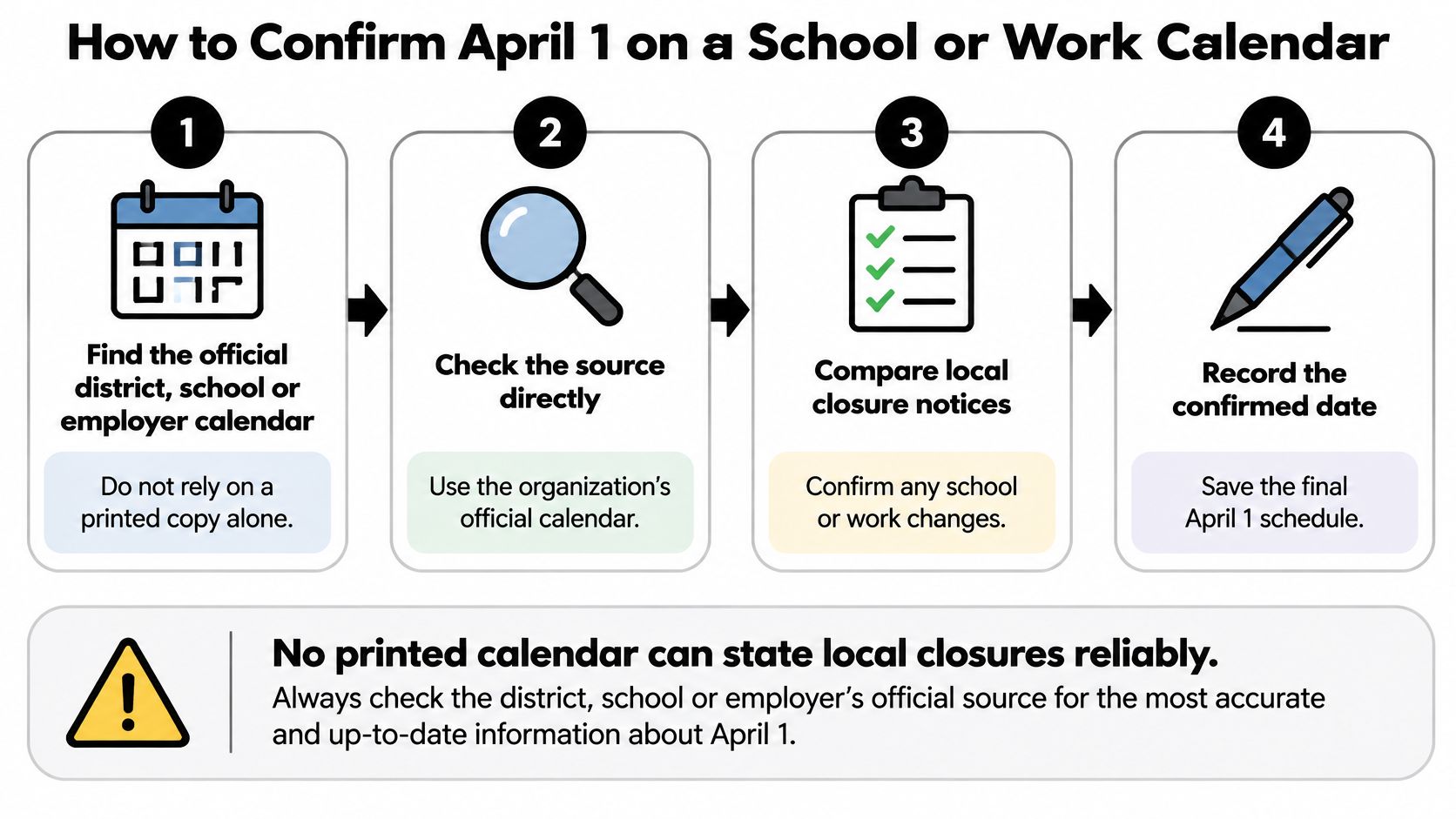
- Go to the official source. A district site, an employee portal, a student handbook. Third-party holiday aggregators rarely track rescheduled days, and they never track a single building's early release.
- Search the week, not the date. Look at the five days around April 1, since spring break frequently swallows the date whole. The Westonka Public Schools calendar illustrates the pattern, listing April 1 and 2, 2027 as spring break.
- Check testing windows too. State assessment periods don't close schools, but they can move start times, restrict absences and change childcare plans for a family.
- Ask whether your employer follows the state, the locality or neither. Observance varies by organisation even inside one city.
- Write the answer down in the calendar margin. A short label such as "No school" or "Spring break" beats a memorised fact, because whoever reads the page next wasn't in the conversation.
- Recheck before printing. Schedules get revised, and the version you printed in the autumn may be obsolete by March.
Before you rely on any entry: calendars are provided for general planning and may contain errors, so check an authoritative source before you commit to a date.
That last point matters more for April than for most months, because spring break, testing and end-of-year planning stack up in the same four weeks. The most useful April page is often a lightly marked one with room for your own confirmed dates, not a dense sheet of observances you'll never use.
April Grid Layout for Any Year
April holds 30 days, so the shape of the printed grid depends entirely on how many blank cells come before the 1st. Start with April 1's weekday from the first section and set the blank count for a Sunday-first grid: Sunday 0, Monday 1, Tuesday 2, Wednesday 3, Thursday 4, Friday 5, Saturday 6.
- Place the 1 in the column matching that weekday.
- Fill days 2 to 30 left to right, wrapping at the end of each row.
- Count the rows by adding the blanks to 30, dividing by 7, and rounding up.
In 2026, April 1 is a Wednesday, which gives 3 blanks and 33 cells. That rounds up to 5 rows, and April 30 lands on a Thursday. In 2028, April 1 is a Saturday, so 6 blanks plus 30 days give 36 cells, 6 rows, and April 30 on a Sunday.
Grids that start on Monday shift every count by one, with Monday as 0 through Sunday as 6. The same 2029 year that produces 5 rows on a Sunday-first sheet needs 6 rows on a Monday-first one, because April 1 is a Sunday and sits at the end of the week. If Monday-first is your convention, a blank calendar starting on Monday gives you the layout without rebuilding it.
Final check: confirm the last row against the weekday of April 30 before you send anything to the printer.
Choose and Print Your April 1st Calendar
The layout choice comes first, because it decides how much room each day gets. A yearly sheet keeps all twelve months on one page for checking dates across the year. A monthly page gives you writing space for appointments, school notices and household notes. The 2027 calendar comes in both forms, either as a single yearly page or as a set of monthly pages.
The setup flow is short, and each step exists to prevent a specific printing failure:
- Pick the layout. Yearly for an overview, monthly for detail. On a monthly layout you can take all twelve pages or just the month you're working in.
- Choose the week start. Sunday or Monday. Match whatever your household or workplace already uses, or every dated note you write will land on the wrong column.
- Select the paper size. US Letter or A4. This has to match the physical paper in the tray.
- Decide on holiday markings. US federal holidays and observed dates can be switched on, or you can print a blank version and add local dates yourself.
- Download the PDF or print from the browser. No account is needed either way.
- Read the print preview and confirm the orientation shown there matches the layout you picked.
- Use fit-to-page if the edges are clipped, then look at the preview once more.
A short walk-through of that sequence makes the settings easier to follow:
If you're planning across the spring quarter rather than a single month, the April, May and June calendar covers the stretch where spring break, testing and the end of the school year collide.
Checklist before printing: confirm April 1's weekday, verify the grid matches your Sunday or Monday choice, and add the school and work dates you confirmed locally.
Recording April 1 in Calendars and Data
The label "April 1" fails as a storage key because it repeats every year and carries no year, no weekday and no week number. A spreadsheet column of April 1 entries tells you nothing about which year each row describes.
| Representation | 2026 | 2027 |
|---|---|---|
| Calendar date | 2026-04-01 | 2027-04-01 |
| ISO week date | 2026-W14-3 | 2027-W13-4 |
| Ordinal date | 2026-091 | 2027-091 |
| Localized label | April 1, 2026 or 1 April 2026 | April 1, 2027 or 1 April 2027 |
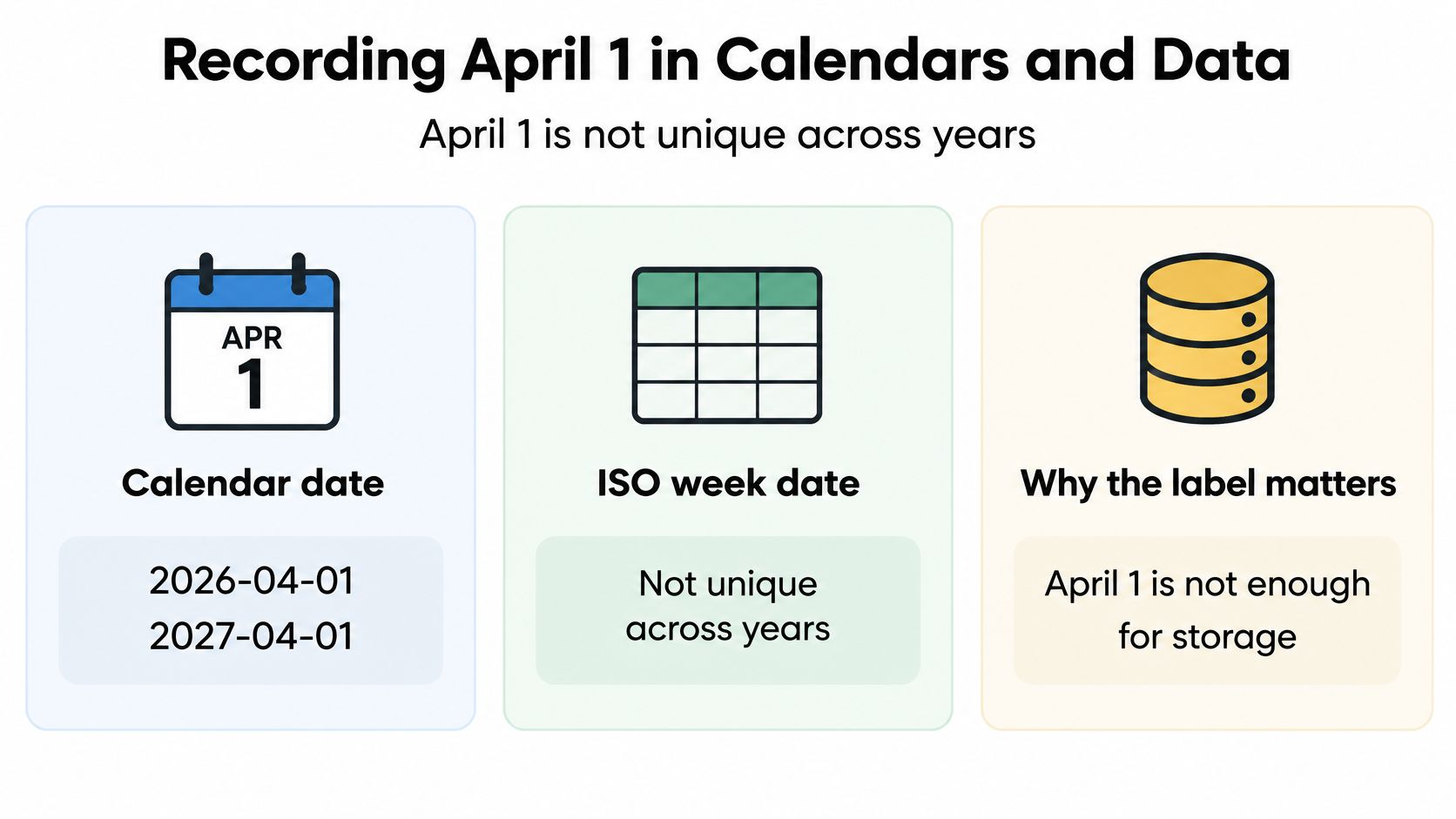
The calendar date format is the safe default. ISO 8601-1:2019, described in the ISO 8601 date and time standard, defines Gregorian date representations for information interchange and removes the ambiguity between MM/DD/YYYY and DD/MM/YYYY conventions. The week date is the risky one: the same standard assigns Monday as 1 through Sunday as 7 and anchors week numbering on the week containing January 4, which can produce a week-year that differs from the calendar year near New Year. Derive it from a validated date library rather than counting weeks by hand.
Three Ways to Write the Same Day
Calendar date, ordinal date and week date are distinct representations rather than variations on one format, a distinction the ISO 8601 calendar and time reference treats explicitly. That matters when a one-page annual overview has to reconcile with monthly planning pages or a scheduling system that thinks in weeks.
April 1 also serves as an official reference date in published statistics. Japan's official statistics portal published a population-estimates dataset measured as of April 1, 2026, and Statistics Poland scheduled 3 news releases for April 1, 2026. Dates stored as labels would make both sets impossible to sort chronologically.
Storage rule: keep the full date as the key, derive weekday and week number at render time, and label the display format in any export.
For display, US readers expect April 1, 2027 and much of the rest of the world expects 1 April 2027. Both are correct renderings of the same 2027-04-01 record.
Origin of April Fools' Day in Brief
The earliest clear documentary reference is a 1561 Flemish poem by Eduard De Dene, in which a nobleman sends his servant on pointless errands and the servant recognises the joke because it is April 1, according to the Library of Congress account of April 1. In English, antiquarian John Aubrey described "Fooles Holy Day" in 1686, and a 1771 diary entry by Anna Green Winslow shows the custom known in Boston and across New England.
The calendar-reform explanation is a theory, not a finding. Medieval France tied New Year to March 25, and Charles IX moved it to January 1 in 1564, while the Gregorian correction of 1582 removed roughly ten days of accumulated drift, as the Library of Congress folklife blog recounts. Mocking people who kept the old date is a plausible story, but a Roman link through the festival of Hilaria remains unproven. None of it changes a single weekday on your printed page.
Dayleaf builds free printable calendars for exactly this kind of planning: a 2027 calendar you can print as a one-page yearly sheet or as a set of monthly pages, with Sunday or Monday week starts, US Letter or A4 output, and US federal holiday markings you can switch off if you'd rather add local dates yourself. Start with the weekday method above, then confirm your district's spring break and any April deadlines before you print. Head to Dayleaf to choose your layout and download the month or year you need.