March 08 Calendar 2026: Day, Week and Holiday Details
March 08 calendar for 2026: it is a Sunday, week 10, day 67 of the year, with holiday status and the 2027 weekday explained.
March 8, 2026 is a Sunday, day 67 of the year, in ISO week 10. The same weekday opens the month, and 298 days remain after that Sunday.
Why do so many March 08 calendar lookups stop at the weekday and still mark the wrong box? A printed grid can slide the date into another column when the week starts on Monday, and a highlighted observance is not the same thing as a day off. The rest of this page fixes both mistakes in order: the weekday, the grid, the year-to-year shift, then the holiday status.
March 8, 2026 Day and Week Details
March 8, 2026 is a Sunday, the same weekday as March 1 of that year. Read the row, then check it on a printed grid before you write anything in the box.
| Detail | Value | Note |
|---|---|---|
| Day of week | Sunday | Same weekday as March 1, 2026 |
| Day of the year | 67 | January 1 counted as day 1 |
| Days left in 2026 | 298 | Days after March 8 through December 31 |
| ISO week number | Week 10 | Runs Monday March 2 to Sunday March 8 |
| Position in a Sunday-start week | First column | Second row of the grid |
| Position in a Monday-start week | Last column | Week runs March 2 to March 8 |
Day of the year counts January 1 as day 1. January has 31 days and February 2026 has 28, so March 8 is day 67. Days left counts only the days after March 8 through December 31, which is 298, not the day itself.
ISO week 10 runs Monday, March 2, through Sunday, March 8. Schedules that number weeks, including many school and payroll systems, treat that Sunday as the last day of the week, not the first.
Layout is where people misread the printout. In a Sunday-start calendar, March 8 sits in the first column of the second row. In a Monday-start calendar, it sits in the last column of the row that begins Monday, March 2. The weekday does not change. Only the column does.
Practical rule: Find March 8 on a printed 2026 grid and confirm it sits in the Sunday column, so the printout matches this table.
Where March 8 Sits in the March 2026 Grid
A Sunday-start month makes the placement obvious, because March 1 opens the top-left corner.
| Calendar row | Dates shown (Sunday start) | Weekend dates in row |
|---|---|---|
| Row 1 | 1 to 7 | Sunday 1, Saturday 7 |
| Row 2 | 8 to 14 | Sunday 8, Saturday 14 |
| Row 3 | 15 to 21 | Sunday 15, Saturday 21 |
| Row 4 | 22 to 28 | Sunday 22, Saturday 28 |
| Row 5 | 29 to 31 | Sunday 29; 30 (Monday) and 31 (Tuesday) are weekdays |
Row 1 holds March 1 to 7. Row 2 holds March 8 to 14, so the date you want is the first cell of that row, beside Saturday, March 14. Rows 3 and 4 repeat the same Sunday-to-Saturday shape. Row 5 is short: Sunday the 29th, then Monday the 30th and Tuesday the 31st.
Because March 1 is a Sunday, a Monday-start grid does not open on March 1. Its first row reaches back to Monday, February 23, and ends on Sunday, March 1. March 8 then moves to the last column, and every row shifts. Compare a printout with this table before you copy appointments across. A February through April calendar is useful when those shifted days spill into the neighboring months.
March 8 falls on a weekend, so it carries no workday in ordinary work or school planning. The Sundays in March 2026 are March 1, 8, 15, 22, and 29.
How the Weekday of March 8 Changes by Year
March 8 has no fixed weekday. A printed calendar from one year cannot be reused for another without checking the header.
| Year | Weekday of March 8 | Change from 2026 |
|---|---|---|
| 2025 | Saturday | One day earlier |
| 2026 | Sunday | Current year |
| 2027 | Monday | One day later |
| 2028 | Wednesday | Three days later |
The weekday moves forward one day in each common year, and by two days when February 29 falls between two March 8 dates. That is why 2028 lands three days after 2026: one day into 2027, then two more across the leap day.
Say a family copies a 2026 wall calendar and leaves March 8 in the Sunday column. In 2027 the date is a Monday, so the box must move one column to the right on a Sunday-start layout. Software should store March 8 as a month-and-day rule and calculate the weekday each year, rather than hard-coding "Sunday." The United Nations calendar records the observance every year on March 8, including March 8, 2027, and it is not tied to a particular weekday.
Check the year in the header before you mark any weekday schedule. Planners using a 2027 layout can start from a March 2027 calendar, where March 8 is a Monday.
Is March 8 a Day Off and How to Verify It
March 8 is not a US federal holiday, so the date alone creates no federal day off. International Women's Day is recognized by the United Nations and observed in many countries as a day recognizing women's achievements and advocating equal rights and opportunities. Legal holiday treatment, school closures, and employment rules vary by country, state, employer, and school.
Label the box International Women's Day (observance) unless an official source confirms time off. The UN Women media advisory gives the 2026 theme as "Rights. Justice. Action. For ALL Women and Girls." A highlighted date is not automatically a public day off.
Check status in this order:
- National or regional calendar: Look up the government list for the country or state where the person works or studies.
- Employer policy: Read the HR page. Time off can differ by employer even inside one city.
- School or district calendar: Closures do not always match the workplace next door.
- Official observance page: Use it for the meaning of the day, not as proof of a local closure.
Then confirm the printout itself:
- Header year: It must match the year you need.
- March 1: Note its weekday. In 2026 that weekday is Sunday.
- Count seven days forward to March 8, which shares that weekday.
- Week-start setting: A Sunday start puts March 8 in the first column. A Monday start puts it in the last. The weekday does not change.
A misaligned grid is the common slip. If you read the row above or below, March 8 looks like a different weekday. Households and multinational teams should verify each location separately.
A printable calendar is for general planning and may contain errors, so check an authoritative source before you rely on a date. Holiday observances and time off can differ by employer, school, state, or locality.
Why March 8 Appears on Calendars Worldwide
March 8 is on calendars because it became the shared date of an international campaign, not because one country invented a spring festival.
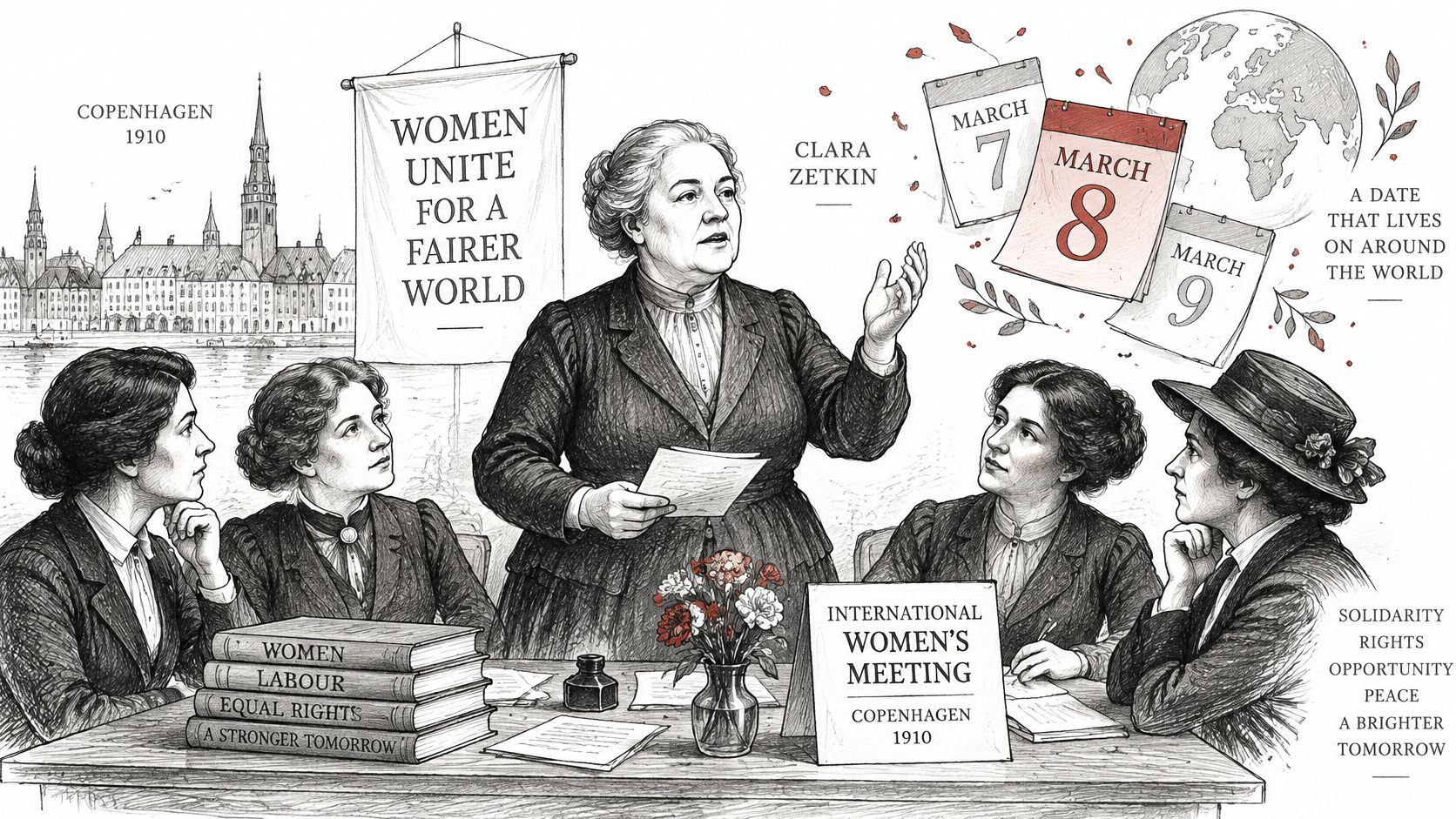
In 1910, more than 100 women representing 17 countries met in Copenhagen, where Clara Zetkin proposed an annual international day focused on women's rights, as the United Nations observance history records. The first observance took place on March 19, 1911, in Austria, Denmark, Germany, and Switzerland. More than 1 million people reportedly participated. They advocated the right to vote, access to work and vocational training, improved labor conditions, and an end to discrimination.
The date itself hardened later. Women in Petrograd demonstrated on March 8, 1917, on the Gregorian calendar. Russia was then using the Julian calendar, where that day was February 23. The protest demanded "bread and peace" amid wartime shortages, and it helped trigger the Russian Revolution. The date was adopted as the official International Women's Day date in 1921.
The United Nations held its first official observance on March 8, 1975, during International Women's Year. The General Assembly formalized a UN observance in 1977. A calendar note can say this in one line: March 8 marks a rights campaign that grew from labor meetings and suffrage demands into a UN observance.
A short film walks through that arc if you want the sequence before you write a caption on the box.
What the 2026 Women's Day Theme Measures
The 2026 theme, Rights. Justice. Action. For ALL Women and Girls, treats March 8 as a check on legal equality, not only a celebration.
Findings released for the day, reported by UN Women, are blunt:
- No country has achieved full legal equality for women and girls.
- Women possess only 64% of men's legal rights worldwide.
- 54% of countries do not define rape on the basis of consent.
- Nearly three in four countries still allow girls to be forced into marriage under national law.
- 44% do not mandate equal pay for work of equal value.
Those figures are why a March 08 calendar entry should not shrink to flowers or a generic "women's celebration." The date is tied to measurable rights, and those rights are not the same in every jurisdiction.
Three planning prompts stay practical:
Schools can review local protections and the materials used that week, so the lesson matches the law students live under.
Households can name unpaid care work on a shared task list, instead of treating it as invisible background.
Workplaces can check whether an event is accessible and safe before they book a room or a speaker.
Legal conditions differ sharply by jurisdiction. Verify local laws and official events rather than treating one country's experience as universal.
Reading Old Dates and Calendar Systems
Two dates can name the same day when the records use different calendars.
The 1917 Petrograd demonstration is the clearest case. UN historical material places the event on February 23 in the Julian calendar then used in Russia, which corresponds to March 8 in the Gregorian calendar used elsewhere. Readers who meet only one of those dates are looking at a 13-day gap, not two separate protests.
Keep both notations instead of converting them without notice:
February 23, 1917 (Julian) / March 8, 1917 (Gregorian)
That label preserves the original record and adds the converted day. Everyday planning does not need this conversion. Gregorian civil dates are the right default for 2026 and 2027 calendars, so current appointments stay as printed.
For anniversary lists and cross-border archives, store the calendar system with each historical date. A milestone reminder then lands on the day you meant, rather than thirteen days early or late.
Dates Near March 8 That Affect Your Schedule
The Sunday itself is only one scheduling problem. The days around it change clocks, weekends, and the first workday after.
In the United States in 2026, daylight saving time begins on March 8, the second Sunday of March. Clocks jump from 2 a.m. to 3 a.m. local time, so that Sunday is one hour shorter for US users. Saturday, March 7, is still on standard time. Monday, March 9, is the first weekday after both the observance and the clock change, which is why a 9 a.m. meeting can feel early.
Further into the month, March 20, 2026, the spring equinox, falls on a Friday. It works as a seasonal marker on a March planner, not as a holiday.
In 2027, March 8 becomes a Monday, so the weekend pattern around it will not match this year. Daylight saving rules also differ by country and region. If you live outside the United States, check your own clock-change date before you set Sunday morning reminders.
Confirm the Date and Choose Your Calendar Format
Confirm the weekday, then pick the format that matches the job. March 8, 2026 is a Sunday. March 8, 2027 is a Monday.
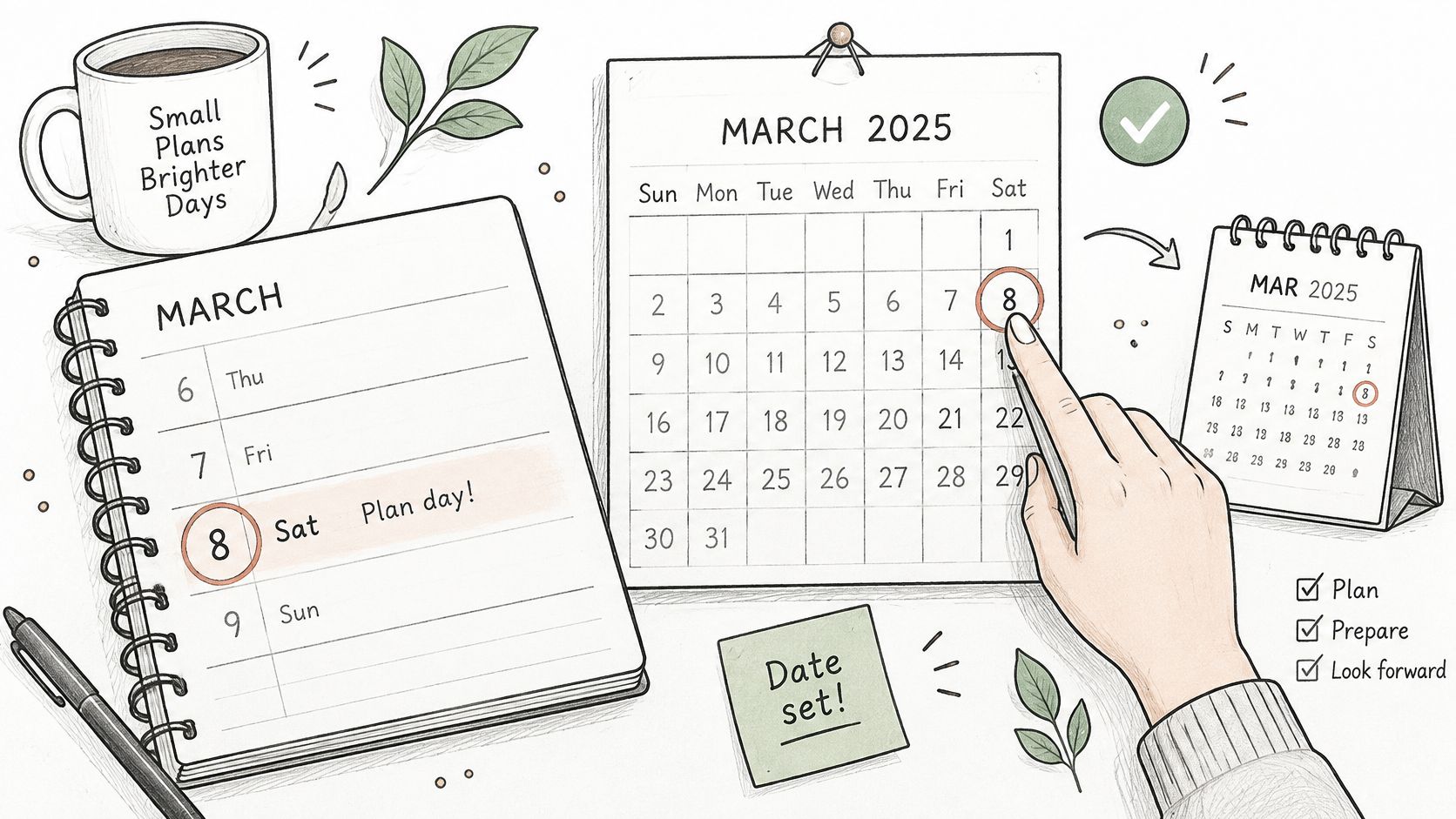
A yearly sheet shows all twelve months on one page when you only need to see where the date sits in the year. Monthly pages leave more room for appointments, school dates, and household notes. You can also compare a Sunday or Monday week start, US Letter or A4 paper, and holiday markings on or off. A blank calendar starting on Monday is the right test if your household already plans Monday to Sunday and you want March 8 in the last column.
Dayleaf offers free printable calendars. You choose a layout, week start, and paper size, then download a PDF or print it. The 2027 tool produces 2027 layouts, so anyone planning 2026 should use a 2026 calendar and check March 8 against the Sunday in the first table.
- Confirm the weekday for the year printed in the header.
- Choose the format, yearly or monthly, and the week start you use.
- Match the printer paper size to the calendar setting before you write entries.
Dayleaf makes free printable calendars for everyday planning, including yearly sheets and monthly pages you can set to a Sunday or Monday start. Use one to place March 8 in the correct column for 2026 or 2027, then print the PDF once the weekday matches this guide. Visit Dayleaf to choose a layout and paper size.