November 08 Calendar: 2026 and 2027 Dates Explained
November 08 calendar reference for 2026 and 2027: weekday, ISO week, printable grid placement, observances and daylight saving planning.
Does a highlighted square tell you everything you need to act on a date? On the 2027 calendar, November 8 sits on a Monday, but the weekday alone won't tell you where to write an appointment, whether a marked observance means a day off, or what time an overseas colleague should join a call.
A useful November 08 calendar carries three pieces of information: the correct year, a clearly labeled week-start setting (Sunday or Monday), and the local clock rules where your readers live. Each one changes what the same printed square means.
Treat the page as a coordination tool, not just a date lookup. The distinction matters most when people share printed pages, use different date formats, or schedule across time zones.
November 8 Weekday and Week Number by Year
November 8, 2027 falls on Monday, the 312th day of the year, in ISO week 45, according to NASA's day-of-year calendar for 2027. Start with the year, not with the look of an old calendar page.
The surrounding rows come from Gregorian calendar arithmetic. An ordinary year shifts the weekday forward by one day, so November 8 moves Saturday, Sunday, then Monday across 2025, 2026 and 2027 while staying on day 312. Between November 2027 and November 2028 a leap day intervenes, so the 2028 date skips a weekday, landing on Wednesday. Because February 29 arrives before November in a leap year, the same date counts as day 313 rather than 312.
| Year | Weekday | Day of year | ISO week |
|---|---|---|---|
| 2025 | Saturday | 312 | 45 |
| 2026 | Sunday | 312 | 45 |
| 2027 | Monday | 312 | 45 |
| 2028 | Wednesday | 313 | 45 |
Each column answers a different question:
- Weekday: Which labeled column should contain the date?
- Day of year: Where does the date fall when counting through the year?
- ISO week: Which Monday-based reporting or planning week contains it?
That steady column of 45s often causes confusion. The week number counts which week the date sits inside, not where in that week it falls, so November 8 remains within week 45 in all four years even as it slides from Saturday to Wednesday. In 2027 it opens the week, since it is a Monday.
Day of year isn't a calendar row number. Likewise, an ISO week number doesn't tell you where a date sits vertically on a printed monthly page.
If you keep reference pages for other months, apply the same year-first check to an April 1st calendar. A familiar month and day can still belong to the wrong annual layout.
Find your intended year, then compare its weekday with the heading on your printed calendar before booking anything. A mismatch is a reason to check the template, not squeeze the appointment into a neighboring cell.
Writing November 8 So Every Reader Reads It Right
Write the month in words for people and use an unambiguous date field for software. A short numeric date can look perfectly clear to its author while meaning a different month to its reader.
The ISO 8601 working document hosted by the Library of Congress supports the year-month-day representation 2027-11-08 and the corresponding week date 2027-W45-1, where the final digit identifies Monday. Its information-interchange conventions help avoid the ambiguity between month-first and day-first notation.
Applied to the Sunday date in the preceding year, the common representations are:
| Format | November 8, 2026 | Best use |
|---|---|---|
| ISO 8601 date | 2026-11-08 | Data exports and sorting |
| ISO week date | 2026-W45-7 | Week-based planning, where 7 means Sunday |
| US numeric | 11/08/2026 | US forms and US-based calendars |
| Day-first numeric | 08/11/2026 | Day-first regions such as most of Europe |
| Long form | Sunday, November 8, 2026 | Invitations and printed notices |
Match the notation to the reader
For a printed invitation, include the weekday, written month, and full year. For a spreadsheet or export, keep the year, month, and day fields complete, including leading zeros where required.
Don't assume that typing an ISO-style date makes a spreadsheet store it correctly. Check the cell type and export preview so the program doesn't reinterpret the entry according to regional settings.
Practical rule: Choose one date convention for each document and apply it consistently, including filenames, headings, and appointment notes.
A written month is particularly helpful when a household notice or school handout may circulate internationally.
Choosing a Week-Start Setting for Shared Calendars
Choose the week start for the people who write on the calendar, not for the printer's default setting. Both Sunday-start and Monday-start layouts can show the correct dates. Confusion begins when users expect different weekday columns.
A household might organize activities around a weekend, while a classroom might group lessons by the working week. Neither preference changes the weekday of an appointment, but it changes how readers scan the page.
Choose by use, not habit alone
Before printing a shared calendar:
- Identify the writers. Include everyone who adds appointments, not just the person who prints the sheet.
- Check their existing planners. Compare school timetables, work schedules, and the household wall calendar.
- Agree on one setting. Keep it consistent across the document.
- Test the page. Ask another user to locate the target date without prompting.
A blank calendar starting on Monday is useful when your group wants working-week planning without extra visual distractions.
A shared calendar works best when nobody has to mentally rearrange its columns.
If a teacher sends calendar pages home, the weekday headings should remain visible and easy to read. Don't crop them to create more writing space. Clear headings do more to prevent misplaced appointments than a familiar-looking arrangement of empty boxes.
Where November 8, 2027 Falls on a Monthly Grid
On a Monday-start grid, November 8, 2027 sits in the first column. On a Sunday-start grid, the same date shifts one column to the right. The weekday never changes; only its position on the page does. That distinction prevents a common error when comparing printed calendars.
The comparison below shows the date under both week-start settings. Check whether a template also displays an entire preceding week.
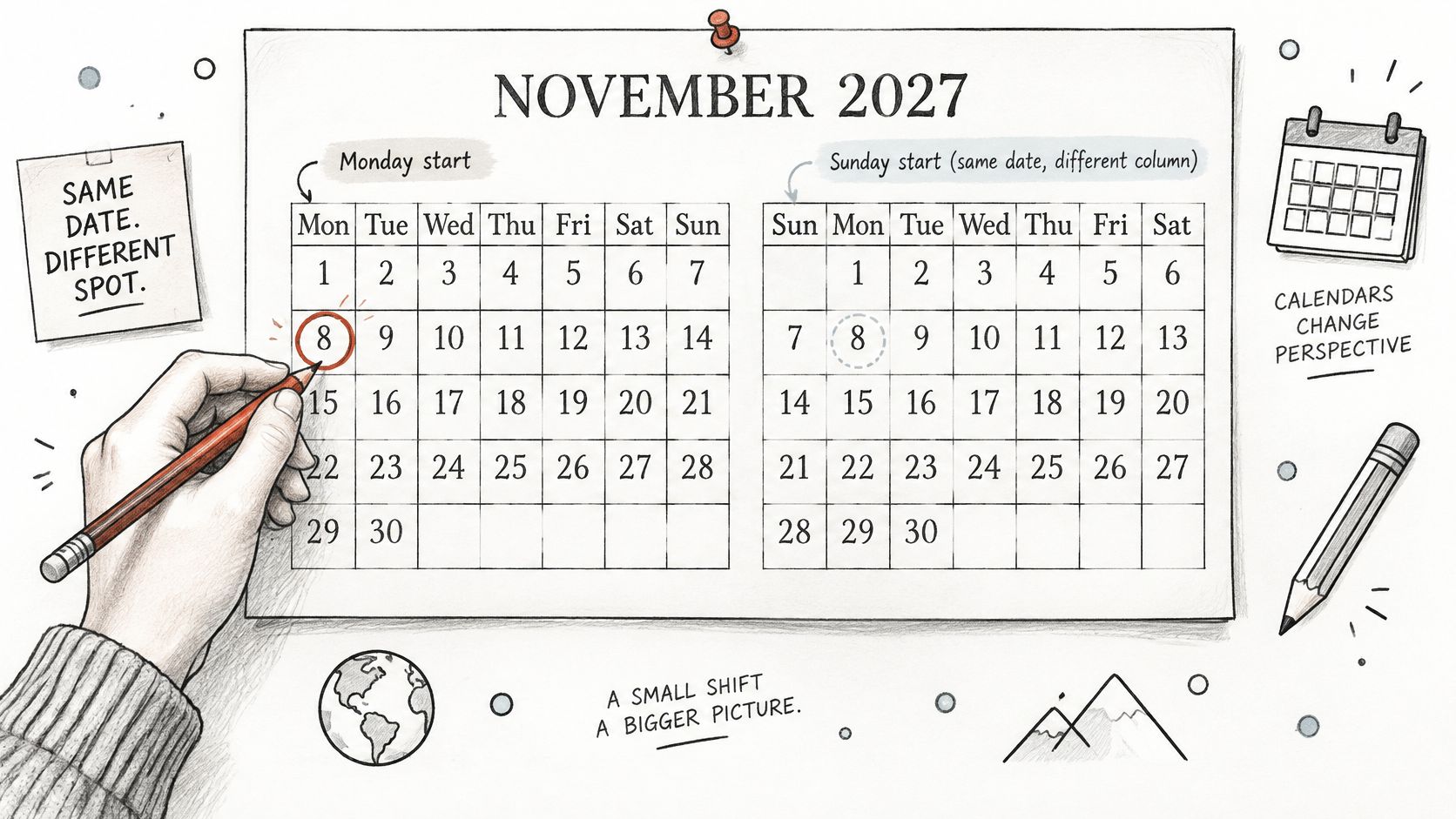
| Week start | Position of November 8 | Row in the grid |
|---|---|---|
| Monday | First column, Monday | Third row, November 8 to 14, if a full preceding-month week is displayed; otherwise second row |
| Sunday | Second column, Monday | Second row, November 7 to 13 |
A Monday-start November page does not need an extra preceding-month row, because the month begins on a Monday. Templates that add one anyway push every visible week downward without changing any weekday. That is why third row is not a universal placement rule.
Verify by counting from the month's opening
Find the cell labeled with the first day of the month. Check its weekday heading, then follow the sequence across the page and onto the next row.
Locate the target date and read its column heading directly. Do not rely on the number of rows above it, because templates can include trailing dates, leading dates, or extra writing space.
The same inspection works when comparing any two monthly pages, such as a March 2027 calendar set to a different week start. Compare headings and date sequences rather than expecting matching row positions.
Before handwriting appointments, confirm that no date has been duplicated or skipped at a row boundary. A different vertical position can be legitimate; an incorrect weekday column is not.
Which Observances Fall on November 8
Classify an observance before deciding what it means for your schedule. A fixed-date awareness day, a Sunday-based commemoration, and a lunar festival follow different rules. None should automatically be treated as a workplace closure.
The November date listing from And Today Is brings together International Day of Radiology, Intersex Day of Remembrance, Remembrance Sunday, World Urbanism Day, local observances, and informal events for November 8, 2026. Its mixed categories illustrate why a long holiday list needs interpretation.
| Observance | Example | Date rule | Official status |
|---|---|---|---|
| Awareness day | Intersex Day of Remembrance | Fixed date, November 8 | Awareness day, not a public holiday |
| Awareness day | International Day of Radiology | Fixed date, November 8 | Awareness observance |
| Commemorative observance | Remembrance Sunday, United Kingdom | Second Sunday in November | Commemoration in the UK |
| Lunar festival | Diwali | Lunar calendar, changes yearly | Major festival in many regions; closure requires local confirmation |
| Local observance | Baku Metro Employees' Day | Fixed date, November 8 | Local observance in Azerbaijan |
| Informal observance | Novelty food or social-media day | Organizer-defined; no single governing authority | Informal, not evidence of a public holiday |
Separate the date rule from the closure rule
Fixed-date observances stay attached to their calendar date even when the weekday changes. They can provide a useful theme for an educational activity without suspending ordinary lessons or appointments.
Rule-based observances must be located afresh on each year's calendar. Don't copy a Sunday commemoration onto Monday just because it appeared beside the same date in an older list.
Lunar-calendar festivals require a year-specific check. A Gregorian date from a previous calendar isn't a reliable recurring reminder.
Country-specific and professional observances need a geographical check too. A date relevant to a local workforce doesn't establish a closure elsewhere.
Confirm what changes for you
Holiday observances and time off can differ by employer, school, state, or locality. Ask the organization responsible for the activity whether its normal schedule applies.
For example, a school might recognize an awareness day through classroom activities while keeping its usual timetable. A community organization might hold a commemorative event without affecting nearby businesses.
Before taking time off, check the relevant government, school, employer, or institutional calendar. Record confirmed closures separately from informational observances so other users don't mistake a themed note for a canceled appointment.
Clock Change and Time Zones for November 8, 2027
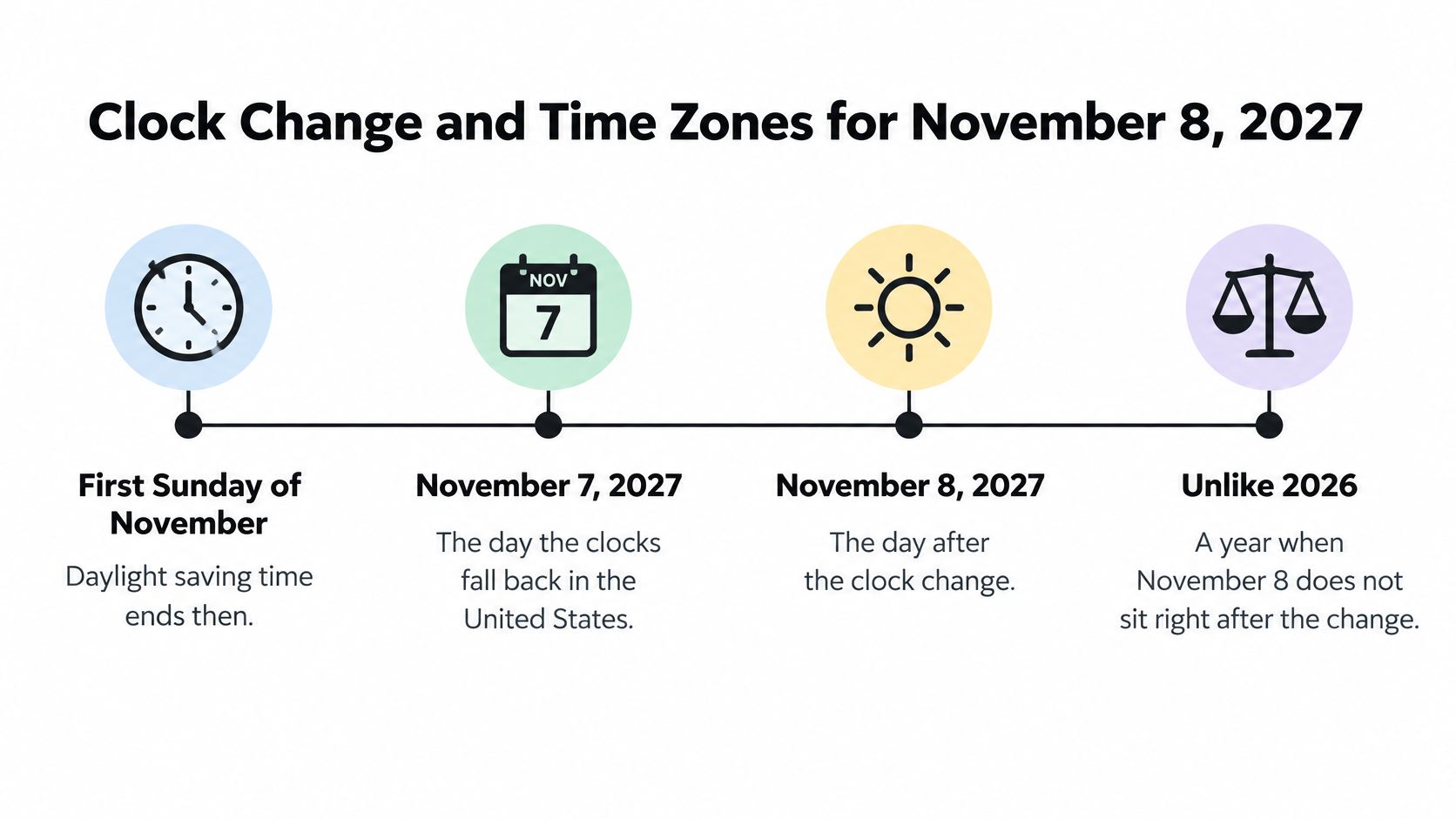
Check the meeting's actual time-zone offset, not the offset you remember from an earlier invitation. The National Institute of Standards and Technology daylight-saving guide explains the US first-Sunday-in-November rule, which places the 2027 change on November 7 and the target Monday immediately afterward in locations following that rule.
Use this timeline to distinguish the clock-change day from the following planning day.
Check each location independently
For an international call, keep these details beside the appointment:
- Location: Record each participant's city or named time zone.
- Local start time: Show what each person should see on their clock.
- Date-specific UTC offset: Confirm it for the appointment rather than reusing an earlier offset.
- Human confirmation: Ask a participant in each location to check the invitation.
Don't depend on an abbreviation alone. A named location in the calendar event gives readers a clearer way to verify the intended zone.
For additional background on the clock-change topic, use the accompanying video.
A US clock change doesn't alter another country's clock rules. However, converting an event between locations can change its displayed local time and, for some appointments, its local calendar date. Check both fields before transferring a digital invitation onto paper.
Monday Routines and Recurring Events on November 8, 2027
Audit recurring appointments rather than copying an entire week unchanged. A Monday label tells you which weekday pattern to inspect, but it doesn't confirm that a particular school, workplace, or household activity will happen.
A weekly lesson, staff meeting, and household collection reminder may follow different schedules. The lesson could follow a term calendar, the meeting could have an organizer-approved exception, and the household service could follow a local timetable.
Review the recurrence, then the exception
Use a short appointment audit:
- Collect Monday entries. Check your wall calendar, phone calendar, school notices, and workplace planner.
- Read the repeat rule. Distinguish every Monday from alternate Mondays or the first Monday of a month.
- Look for exclusions. Check term breaks, organizer cancellations, travel, and approved time off.
- Confirm ownership. Ask the teacher, meeting organizer, or service operator when the schedule isn't explicit.
For a shared household calendar, write only confirmed activities in ink. Use a pencil note or a clear tentative label when you're still waiting for confirmation.
A recurring reminder is a prompt to check an event, not proof that the event will take place.
Be careful with weekly planners that arrange days vertically. On those pages, Monday may occupy a separate horizontal band rather than a monthly-calendar column. Read the weekday label instead of transferring a position from another layout.
Finally, separate preparation from attendance. A meeting may require a document beforehand, while a school activity may require equipment packed the previous evening. Add those tasks to their own dates instead of crowding everything into the appointment cell.
Confirm November 8, 2027 Before You Plan
Finish with a verification pass before treating the page as your working schedule. Check the year, weekday heading, date sequence, and any closure that affects your plans against an authoritative calendar or the institution responsible for the event.
Our calendars are for general planning and may contain errors. A clear printout is useful, but it doesn't replace confirmation of a school closure, workplace arrangement, or appointment time.
Prepare a usable working copy
Choose a yearly sheet when you need an overview, or monthly pages when you need room for handwriting. Our free calendar offers both formats, with a choice of week start.
Before printing:
- Match the paper settings. Use the same paper size in the calendar selection and printer dialog.
- Inspect the preview. Check the weekday headings and edges; use fit-to-page if the printout is clipped.
- Mark the verified date. Add the appointment, its time zone when relevant, and any confirmed preparation task.
Keep the finished copy somewhere everyone who uses it can consult it. Open your calendar and mark the verified date before adding the rest of your plans.
Dayleaf offers free printable yearly and monthly calendars for everyday planning. Visit Dayleaf, choose your week-start setting, and prepare a November calendar you can check, mark, and share.